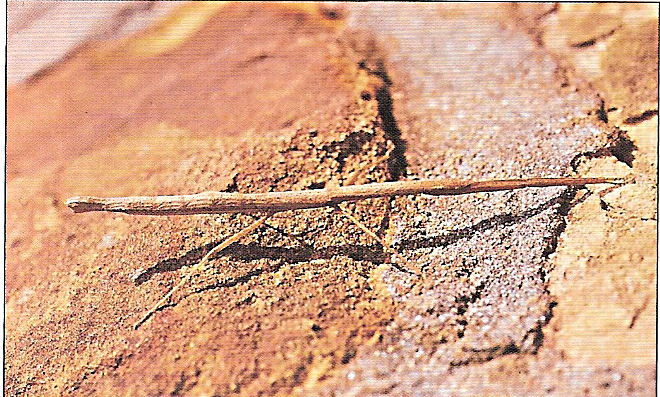
SpeciesLaboratory Stick-insect; Indian Stick-insect
Carausius morosus Brunner von Wattenwyl, 1907
Nomenclature (224)
- Dixippus morosus (Brunner von Wattenwyl, 1907) in Schmitz, 1906: 385-407.
- Carausius morosus Brunner von Wattenwyl, 1907: 268.
Syntype; male; d493d077-105a-413b-b0fe-970d9f7be5ee; deposited at: Museum National d'Histoire Naturelle, Paris (MNHN); India: Shembagonur. Syntype; female; c43a70c9-8b86-4ebc-9533-98b8a25d5a2a; deposited at: Museum National d'Histoire Naturelle, Paris (MNHN); India: Shembagonur. Syntype; male; b80e3ed5-5487-4b4d-8f6c-10dfed95b78c; deposited at: Museum National d'Histoire Naturelle, Paris (MNHN); India: Mission Maduré. Syntypes (n= 2); female; c5b8d3dd-78a3-4c2e-97af-2cdd738980b3; deposited at: Museum National d'Histoire Naturelle, Paris (MNHN); India. Syntype; female; a9fe88bf-d48d-4388-88b4-6bcfebbcff05; deposited at: Museum National d'Histoire Naturelle, Paris (MNHN); India: Kod[ikanel]
- Dixippus morosus (Brunner von Wattenwyl, 1907) in Pantel & Sinéty, 1908: 1.
- Dixippus morosus (Brunner von Wattenwyl, 1907) in Fellmann, 1908: 360.
- Dixippus (Carausius) morosus (Brunner von Wattenwyl, 1907) in La Baume, 1908: 53.
- Dixippus morosus (Brunner von Wattenwyl, 1907) in Meissner, 1909: 87.
- Dixippus morosus (Brunner von Wattenwyl, 1907) in Wanach, 1910: 129.
- Carausius (Dixippus) morosus Brunner von Wattenwyl, 1907 in Schmidt, 1913: 193. Behavior
- Carausius morosus Brunner von Wattenwyl, 1907 in Schmit-Jensen, 1914: 528.
- Dixippus morosus (Brunner von Wattenwyl, 1907) in Meissner, 1916: 37.
- Carausius morosus Brunner von Wattenwyl, 1907 in Roth, 1917: 345.
- Carausius morosus Brunner von Wattenwyl, 1907 in Pantel, 1918: 575. Image or description
- Carausius morosus Brunner von Wattenwyl, 1907 in Chopard, 1920: 265-266. Image or description; Phylogeny or classification
- Carausius morosus Brunner von Wattenwyl, 1907 in Talbot, 1920: 285.
- Dixippus morosus (Brunner von Wattenwyl, 1907) in Przibram & Brecher, 1922: 147. Behavior
- Dixippus morosus (Brunner von Wattenwyl, 1907) in Nachtsheim, 1923: 287. Life history; Physiology
- Carausius morosus Brunner von Wattenwyl, 1907 in Leuzinger, 1925: 1, figs.
- Carausius morosus Brunner von Wattenwyl, 1907 in Leuzinger, Wiesmann & Lehmann, 1926: 1, figs. Economic matters
- Dixippus morosus (Brunner von Wattenwyl, 1907) in Toumanoff, 1927: 1388.
- Carausius morosus Brunner von Wattenwyl, 1907 in Meissner & Elkind, 1928: 466.
- Dixippus (Carausius) morosus (Brunner von Wattenwyl, 1907) in Toumanoff, 1928: 388.
- Carausius morosus Brunner von Wattenwyl, 1907 in Cappe de Baillon, 1931: 5. Structure
- Carausius morosus Brunner von Wattenwyl, 1907 in Metalnikoff, 1932: 313.
- Carausius morosus Brunner von Wattenwyl, 1907 in Meissner, 1934: 1.
- Carausius morosus Brunner von Wattenwyl, 1907 in Thomas, 1934: 1.
- Carausius morosus Brunner von Wattenwyl, 1907 in Pflugfelder, 1937: 477.
- Dixippus morosus (Brunner von Wattenwyl, 1907) in Polak, 1939: 164, fig. Image or description
- Carausius morosus Brunner von Wattenwyl, 1907 in Hewlett, 1940: 199.
- Carausius morosus Brunner von Wattenwyl, 1907 in Yasumatsu, 1942: 17, fig..
- Carausius morosus Brunner von Wattenwyl, 1907 in Nel, 1952: 449. Physiology
- Carausius morosus Brunner von Wattenwyl, 1907 in Nel, 1953: 1451. Physiology
- Carausius morosus Brunner von Wattenwyl, 1907 in Basden, 1955: 201.
- Carausius morosus Brunner von Wattenwyl, 1907 in Urvoy, 1958: 183, figs.
- Carausius morosus Brunner von Wattenwyl, 1907 in Bergerard, 1958: 1930. Structure
- Carausius morosus Brunner von Wattenwyl, 1907 in Bergerard, 1961: 2149. Structure
- Carausius morosus Brunner von Wattenwyl, 1907 in Ebner, 1961: 32.
- Carausius morosus Brunner von Wattenwyl, 1907 in Bergerard, 1962: 137.
- Carausius morosus Brunner von Wattenwyl, 1907 in Stanek, 1962: 101, figs. Image or description
- Carausius morosus Brunner von Wattenwyl, 1907 in Bart, 1965: 1901.
- Carausius morosus Brunner von Wattenwyl, 1907 in Ragge, 1965: 40, figs. Image or description; Specimen or distribution
- Carausius morosus Brunner von Wattenwyl, 1907 in Bart, 1965: 5619.
- Carausius morosus Brunner von Wattenwyl, 1907 in Bart, 1966: 2163.
- Carausius morosus Brunner von Wattenwyl, 1907 in Pijnacker, 1966: 99. Life history
- Carausius morosus Brunner von Wattenwyl, 1907 in Sire, 1967: 215, figs.
- Carausius morosus Brunner von Wattenwyl, 1907 in Orlando & Corbino, 1967: 261.
- Carausius morosus Brunner von Wattenwyl, 1907 in Pijnacker, 1967: 545.
- Carausius morosus Brunner von Wattenwyl, 1907 in Pijnacker, 1968: 149.
- Carausius morosus Brunner von Wattenwyl, 1907 in Cavallin, 1969: 2189.
- Carausius morosus Brunner von Wattenwyl, 1907 in Thomas, 1969
- Carausius morosus Brunner von Wattenwyl, 1907 in Scali, 1969: 413.
- Carausius morosus Brunner von Wattenwyl, 1907 in Crotch & Et Al., 1970: 1, figs. Image or description
- Carausius morosus Brunner von Wattenwyl, 1907 in Bauchhenss, 1971: 1.
- Carausius morosus Brunner von Wattenwyl, 1907 in Kleinhout, 1972: 331. Behavior
- Carausius morosus Brunner von Wattenwyl, 1907 in Bergerard, 1972: 57.
- Carausius morosus Brunner von Wattenwyl, 1907 in Beadle, 1972: 71, figs.
- Carausius morosus Brunner von Wattenwyl, 1907 in Wigglesworth, 1972: 735.
- Carausius morosus Brunner von Wattenwyl, 1907 in Ragge, 1973: 228.
- Carausius morosus Brunner von Wattenwyl, 1907 in Sellick, 1974: 52, figs.
- Carausius morosus Brunner von Wattenwyl, 1907 in Kleinhout, 1974: 151. Behavior
- Carausius morosus Brunner von Wattenwyl, 1907 in Seiler, 1974: 2.
- Carausius morosus Brunner von Wattenwyl, 1907 in Nicolson, Horsfield, Gardiner & Maddrell, 1974: 2061.
- Carausius morosus Brunner von Wattenwyl, 1907 in Sellick, 1975: 1. Phylogeny or classification
- Carausius morosus Brunner von Wattenwyl, 1907 in Sellick, 1977: 139.
- Carausius morosus Brunner von Wattenwyl, 1907 in Bedford, 1978: 125.
- Carausius morosus Brunner von Wattenwyl, 1907 in Larink, 1978: 133.
- Carausius morosus Brunner von Wattenwyl, 1907 in Cassidy, 1978: 87.
- Carausius morosus Brunner von Wattenwyl, 1907 in Thomas, 1979: 347.
- Carausius morosus Brunner von Wattenwyl, 1907 in Thomas, 1979: 811. Behavior
- Carausius morosus Brunner von Wattenwyl, 1907 in Pijnacker & Ferwerda, 1980: 105.
- Carausius morosus Brunner von Wattenwyl, 1907 in Mazzini & Scali, 1980: 369.
- Carausius morosus Brunner von Wattenwyl, 1907 in Sellick, 1980: 43, fig. 8. Phylogeny or classification
- Carausius morosus Brunner von Wattenwyl, 1907 in Vanschuytbroeck & Cools, 1981: 3. Specimen or distribution
- Carausius morosus Brunner von Wattenwyl, 1907 in Schindler, 1981: 249.
- Carausius morosus Brunner von Wattenwyl, 1907 in Hinton, 1981: 534. Image or description
- Carausius morosus Brunner von Wattenwyl, 1907 in Ferwerda & Pijnacker, 1982: 67. Phylogeny or classification
- Carausius morosus Brunner von Wattenwyl, 1907 in Bässler, 1983: 1. Behavior; Economic matters
- Carausius morosus Brunner von Wattenwyl, 1907 in Bässler & Wegner, 1983: 127. Structure
- Carausius morosus Brunner von Wattenwyl, 1907 in Bullini, 1985: 123. Phylogeny or classification
- Carausius morosus Brunner von Wattenwyl, 1907 in Brock, 1985: 5, 8, figs. Image or description
- Carausius morosus Brunner von Wattenwyl, 1907 in Deschandol, 1985: 6.
- Carausius morosus Brunner von Wattenwyl, 1907 in Carlberg, 1986: 1.
- Carausius morosus Brunner von Wattenwyl, 1907 in Carlberg, 1986: 373. Behavior
- Carausius morosus Brunner von Wattenwyl, 1907 in Carlberg, 1986: 39.
- Carausius morosus Brunner von Wattenwyl, 1907 in Carlberg, 1986: 641. Life history
- Carausius morosus Brunner von Wattenwyl, 1907 in Bradley & Giorgi, 1987: 11. Phylogeny or classification
- Carausius morosus Brunner von Wattenwyl, 1907 in Weiland, 1987: 113.
- Carausius morosus Brunner von Wattenwyl, 1907 in Baccetti, 1987: 120. Phylogeny or classification
- Carausius morosus Brunner von Wattenwyl, 1907 in Masetti, 1987: 149.
- Carausius morosus Brunner von Wattenwyl, 1907 in Viscuso & Longo, 1987: 175. Phylogeny or classification
- Carausius morosus Brunner von Wattenwyl, 1907 in Bullini & Nascetti, 1987: 187. Phylogeny or classification
- Carausius morosus Brunner von Wattenwyl, 1907 in Pijnacker, 1987: 203. Behavior
- Carausius morosus Brunner von Wattenwyl, 1907 in Giorgi & Mazzini, 1987: 21. Phylogeny or classification
- Carausius morosus Brunner von Wattenwyl, 1907 in Mazzini & Giorgi, 1987: 39. Phylogeny or classification
- Carausius morosus Brunner von Wattenwyl, 1907 in Carlberg, 1987: 1. Life history
- Carausius morosus Brunner von Wattenwyl, 1907 in Pijnacker & Ferwerda, 1987: 47. Phylogeny or classification
- Carausius morosus Brunner von Wattenwyl, 1907 in Pijnacker & Koch, 1987: 49.
- Carausius morosus Brunner von Wattenwyl, 1907 in Schjeide & Schmidt, 1987: 52. Phylogeny or classification
- Carausius morosus Brunner von Wattenwyl, 1907 in Spinetti, 1987: 71. Phylogeny or classification
- Carausius morosus Brunner von Wattenwyl, 1907 in Bässler, 1987: 79. Phylogeny or classification
- Carausius morosus Brunner von Wattenwyl, 1907 in Cruse, Knauth & Schwarze, 1987: 87. Phylogeny or classification
- Carausius morosus Brunner von Wattenwyl, 1907 in Gäde, 1987: 97. Physiology
- Carausius morosus Brunner von Wattenwyl, 1907 in Marshall & Haes, 1988: 143. Image or description; Specimen or distribution; Key
- Carausius morosus Brunner von Wattenwyl, 1907 in Saure, 1988: 8. Behavior
- Carausius morosus Brunner von Wattenwyl, 1907 in Sellick, 1988: 280. Phylogeny or classification
- Carausius morosus Brunner von Wattenwyl, 1907 in Bullini & Nascetti, 1988: 143. Phylogeny or classification
- Carausius morosus Brunner von Wattenwyl, 1907 in Bullini & Nascetti, 1989: 329. Phylogeny or classification
- Carausius morosus Brunner von Wattenwyl, 1907 in Haes, 1990: 32. Specimen or distribution
- Carausius morosus Brunner von Wattenwyl, 1907 in Kevan, 1990: 25. Specimen or distribution
- Carausius morosus Brunner von Wattenwyl, 1907 in Bullini & Nascetti, 1990: 1747. Phylogeny or classification
- Carausius morosus Brunner von Wattenwyl, 1907 in Nentwig, 1990: 446.
- Carausius morosus Brunner von Wattenwyl, 1907 in O'Toole, 1990: 34, fig. Image or description
- Carausius morosus Brunner von Wattenwyl, 1907 in Stone, 1992: 158.
- Carausius morosus Brunner von Wattenwyl, 1907 in Malavasi, 1992: 209. Specimen or distribution
- Carausius morosus Brunner von Wattenwyl, 1907 in Carlberg, 1992: 229.
- Carausius morosus Brunner von Wattenwyl, 1907 in Dean, 1992: 345.
- Carausius morosus Brunner von Wattenwyl, 1907 in Alderton, 1992: 50, figs.
- Carausius morosus Brunner von Wattenwyl, 1907 in Brock, 1992: 15, figs.
- Carausius morosus Brunner von Wattenwyl, 1907 in Schulten, 1995: 39, figs..
- Carausius morosus Brunner von Wattenwyl, 1907 in Lelong, 1995: 14.
- Carausius morosus Brunner von Wattenwyl, 1907 in Brock, 1995: 25.
- Carausius morosus Brunner von Wattenwyl, 1907 in Crosby-Clark, 1995: 6. Specimen or distribution
- Carausius morosus Brunner von Wattenwyl, 1907 in More, 1996: 62. Life history
- Carausius morosus Brunner von Wattenwyl, 1907 in Martinez & Gauvrit, 1997: 324. Specimen or distribution
- Carausius morosus Brunner von Wattenwyl, 1907 in Alderton, 1997: 8, fig. Image or description
- Carausius morosus Brunner von Wattenwyl, 1907 in Haes & Harding, 1997: 52. Specimen or distribution
- Carausius morosus Brunner von Wattenwyl, 1907 in Lipinski, Greven, Schulten & Löser, 1999: 24, figs.
- Carausius morosus Brunner von Wattenwyl, 1907 in Haes, 1999: 62. Specimen or distribution
- Carausius morosus Brunner von Wattenwyl, 1907 in Brock, 1999: 39.
- Carausius morosus Brunner von Wattenwyl, 1907 in Brock, 2000: 31, figs.
- Carausius morosus Brunner von Wattenwyl, 1907 in Seiler, Bradler & Koch, 2000: 57, figs.
- Carausius morosus Brunner von Wattenwyl, 1907 in Bühler, 2000: 15. Image or description
- Carausius morosus Brunner von Wattenwyl, 1907 in Brock, 2000: 2. Specimen or distribution; Life history; Behavior
- Carausius morosus Brunner von Wattenwyl, 1907 in Zompro, 2000: 64. Specimen or distribution
- Carausius morosus Brunner von Wattenwyl, 1907 in Dürr, König & Kittmann, 2001: 131. Physiology
- Carausius morosus Brunner von Wattenwyl, 1907 in Marshall, 2001: 336. Specimen or distribution
- Carausius morosus Brunner von Wattenwyl, 1907 in Baxter, 2002: 8, 40, figs.
- Carausius morosus Brunner von Wattenwyl, 1907 in Diederich, Schumm & Cruse, 2002: 165-173.
- Carausius morosus Brunner von Wattenwyl, 1907 in Monteforti, Angeli, Petacchi & Minnocci, 2002: 195.
- Carausius morosus Brunner von Wattenwyl, 1907 in Cecchettini, Scarcelli, Locci, Masetti & Giorgi, 2002: 243.
- Carausius morosus Brunner von Wattenwyl, 1907 in Alderton, 2002: 8, fig. Image or description
- Carausius morosus Brunner von Wattenwyl, 1907 in Anonymous, 2002: 9. Life history
- Carausius morosus Brunner von Wattenwyl, 1907 in Urbach & Technau, 2003: 103.
- Carausius morosus Brunner von Wattenwyl, 1907 in Bucher, Akay, DiCaprio & Büschges, 2003: 1245.
- Carausius morosus Brunner von Wattenwyl, 1907 in Baessler, Sauer & Büschges, 2003: 125.
- Carausius morosus Brunner von Wattenwyl, 1907 in Brock, 2003: 227, fig. 1, 229.
- Carausius morosus Brunner von Wattenwyl, 1907 in Whiting, Bradler & Maxwell, 2003: 265.
- Carausius morosus Brunner von Wattenwyl, 1907 in Meyer-Rochow & Keskinen, 2003: 281.
- Carausius morosus Brunner von Wattenwyl, 1907 in Cecchettini, Locci, Masetti, Fausto, Gambellini, Mazzini & Giorgi, 2003: 39.
- Carausius morosus Brunner von Wattenwyl, 1907 in Brock, 2003: 17.
- Carausius morosus Brunner von Wattenwyl, 1907 in Picker, Griffiths & Weaving, 2004: 108, fig.. Image or description
- Carausius morosus Brunner von Wattenwyl, 1907 in Krause & Duerr, 2004: 168.
- Carausius morosus Brunner von Wattenwyl, 1907 in Ekeberg, Bluemel & Büschges, 2004: 287.
- Carausius morosus Brunner von Wattenwyl, 1907 in Fausto, Gambellini, Mazzini, Cecchettini, Locci, Masetti & Giorgi, 2004: 411.
- Carausius morosus Brunner von Wattenwyl, 1907 in Cruse, Kuehn, Park & Schmitz, 2004: 983.
- Carausius morosus Brunner von Wattenwyl, 1907 in Ludwar, Goeritz & Schmidt, 2005: 1255.
- Carausius morosus Brunner von Wattenwyl, 1907 in Duerr & Ebeling, 2005: 2237.
- Carausius morosus Brunner von Wattenwyl, 1907 in Duerr, 2005: 2253.
- Carausius morosus Brunner von Wattenwyl, 1907 in Jander & Wendler, 2005: 239.
- Carausius morosus Brunner von Wattenwyl, 1907 in Ludwar, Westmark, Büschges & Schmidt, 2005: 2772.
- Carausius morosus Brunner von Wattenwyl, 1907 in Otte & Brock, 2005: 86.
- Carausius morosus Brunner von Wattenwyl, 1907 in Fausto, Gambellini, Mazzini, Cecchettini & Giorgi, 2005: 89.
- Carausius morosus Brunner von Wattenwyl, 1907 in Schumm & Cruse, 2006: 1147.
- Carausius morosus Brunner von Wattenwyl, 1907 in Drechsler & Federle, 2006: 1213.
- Carausius morosus Brunner von Wattenwyl, 1907 in Rosano & Webb, 2006: 150.
- Carausius morosus Brunner von Wattenwyl, 1907 in Lee, 2006: 23.
- Carausius morosus Brunner von Wattenwyl, 1907 in Hooper, Guschlbauer, Uckermann & Büschges, 2006: 2072.
- Carausius morosus Brunner von Wattenwyl, 1907 in Ebeling & Duerr, 2006: 2199.
- Carausius morosus Brunner von Wattenwyl, 1907 in Bueckmann & Maisch, 2006: 297.
- Carausius morosus Brunner von Wattenwyl, 1907 in Maginnis, 2006: 858.
- Carausius morosus Brunner von Wattenwyl, 1907 in Westmark, 2007: 1. Physiology
- Carausius morosus Brunner von Wattenwyl, 1907 in Borgmann, Scharstein & Büschges, 2007: 1685. Behavior
- Carausius morosus Brunner von Wattenwyl, 1907 in Hooper, Guschlbauer, Uckermann & Büschges, 2007: 1718.
- Carausius morosus Brunner von Wattenwyl, 1907 in Cliquennois, 2007: 14.
- Carausius morosus Brunner von Wattenwyl, 1907 in Mujagic, Krause & Duerr, 2007: 313.
- Carausius morosus Brunner von Wattenwyl, 1907 in Bonnet, Ducret & Trystram, 2007: 39.
- Carausius morosus Brunner von Wattenwyl, 1907 in Chavignon, Dhondt & Molto, 2007: 8.
- Carausius morosus Brunner von Wattenwyl, 1907 in La Brijn, 2007: 8.
- Carausius morosus Brunner von Wattenwyl, 1907 in van de Kamp & Greven, 2007: 99.
- Carausius morosus Brunner von Wattenwyl, 1907 in Kirby & Beck, 2008: 185. Physiology
- Carausius morosus Brunner von Wattenwyl, 1907 in Buckley, Attanayake & Bradler, 2009: 1058. Phylogeny or classification
- Carausius morosus Brunner von Wattenwyl, 1907 in Lee, 2009: 18. Specimen or distribution
- Carausius morosus Brunner von Wattenwyl, 1907 in Mandal & Yadav, 2010: 36. Phylogeny or classification
- Carausius morosus Brunner von Wattenwyl, 1907 in Rosenbaum, Wosnitza, Bueschges & Gruhn, 2010: 1681. Physiology
- Carausius morosus Brunner von Wattenwyl, 1907 in Marshall, 2010: 537. Specimen or distribution
- Carausius morosus Brunner von Wattenwyl, 1907 in Narita, Pereira, Kjellberg & Kageyama, 2010: 74. Structure
- Carausius morosus Brunner von Wattenwyl, 1907 in Rasplus & Roques, 2010: 812. Specimen or distribution
- Carausius morosus Brunner von Wattenwyl, 1907 in Barnard, 2011: 65. Specimen or distribution
- Carausius morosus Brunner von Wattenwyl, 1907 in Bußhardt, Gorb & Wolf, 2011: 1676.
- Carausius morosus Brunner von Wattenwyl, 1907 in Harman, 2011: 6. Specimen or distribution
- Carausius morosus Brunner von Wattenwyl, 1907 in Cliquennois, 2012: 2, fig.. Specimen or distribution
- Carausius morosus Brunner von Wattenwyl, 1907 in Bußhard, Wolf & Gorb, 2012 Behavior
- Carausius morosus Brunner von Wattenwyl, 1907 in Aguiar, Aguín-Pombo & Gonçalves, 2014: 1. Image or description; Specimen or distribution; Life history
- Carausius morosus Brunner von Wattenwyl, 1907 in Shelomi, Jasper, Atallah, Kimsey & Johnson, 2014: 1. Structure
- Carausius morosus Brunner von Wattenwyl, 1907 in Brock, 2014: 18, figs. Image or description; Specimen or distribution
- Carausius morosus Brunner von Wattenwyl, 1907 in Theunissen, Hertrich, Wiljes, Zell, Behler, Krause, Bekemeier, Cimiano, Botsch & Dürr, 2014: 308.
- Carausius morosus Brunner von Wattenwyl, 1907 in Brock, 2014: 36, figs. Image or description
- Carausius morosus Brunner von Wattenwyl, 1907 in Shelomi, Sitepu, Boundy-Mills & Kimsey, 2015: 2. Structure
- Carausius morosus Brunner von Wattenwyl, 1907 in Stolz, von Bredow, von Bredow, Lakes-Harlan, Trenczek & Strauss, 2015: 1.
- Carausius morosus Brunner von Wattenwyl, 1907 in Baker, 2015: 14. Ecological data
- Carausius morosus Brunner von Wattenwyl, 1907 in Bradler, 2015: 4, fig. Image or description; Phylogeny or classification
- Carausius morosus Brunner von Wattenwyl, 1907 in Sutton, 2015: 50. Specimen or distribution
- Carausius morosus Brunner von Wattenwyl, 1907 in Gottardo, Vallotto & Beutel, 2015: 198.
- Carausius morosus Brunner von Wattenwyl, 1907 in Theunissen, Bekemeier & Dürr, 2015: 340.
- Carausius morosus Brunner von Wattenwyl, 1907 in Shelomi, 2016: 22.
- Carausius morosus Brunner von Wattenwyl, 1907 in Brock, 2017: 72, figs. Image or description
- Carausius morosus Brunner von Wattenwyl, 1907 in Schmitt, Büscher, Gorb & Rajabi, 2018: 1-10. Life history; Economic matters
- Carausius morosus Brunner von Wattenwyl, 1907 in Lee, 2018: 25. Specimen or distribution
- Carausius morosus Brunner von Wattenwyl, 1907 in Bradler & Buckley, 2018: 282, fig. Image or description
- Carausius morosus Brunner von Wattenwyl, 1907 in Büscher, Buckley, Grohmann, Gorb & Bradler, 2018: 1-11.
- Carausius morosus Brunner von Wattenwyl, 1907 in Simon, Letsch, Bank, Buckley, Donath, Liu, Machida, Meusemann, Misof, Podsiadlowski, Zhou, Wipfler & Bradler, 2019: 3, fig 1E. Image or description
- Carausius morosus Brunner von Wattenwyl, 1907 in Delfosse, Cliquennois, Depraetere & Robillard, 2019: 215. Phylogeny or classification; Specimen or distribution
- Carausius morosus Brunner von Wattenwyl, 1907 in Smitheman, 2020: 16, figs. Image or description
- Carausius morosus Brunner von Wattenwyl, 1907 in Moate, 2020: 8, figs. Image or description; Specimen or distribution
- Carausius morosus Brunner von Wattenwyl, 1907 in Strauss, Moritz & Rühr, 2021: 3. Structure
- Carausius morosus Brunner von Wattenwyl, 1907 in Moate, 2021: 18, figs. Physiology
- Carausius morosus Brunner von Wattenwyl, 1907 in Brock, 2021: 123, figs. Image or description
- Carausius morosus Brunner von Wattenwyl, 1907 in Brock & Büscher, 2022: pl. 25.2, 350, 525, figs. Image or description; Specimen or distribution
- Carausius morosus Brunner von Wattenwyl, 1907 in Cliquennois & Bradler, 2022: 1193. Specimen or distribution
- Carausius morosus Brunner von Wattenwyl, 1907 in Luna, 2022: 94. Specimen or distribution
- Carausius morosus Brunner von Wattenwyl, 1907 in McGavin & Davranoglou, 2023: 116.
- Carausius morosus Brunner von Wattenwyl, 1907 in Munro & Thacker, 2025: 9-13. Specimen or distribution
- Carausius morosus Brunner von Wattenwyl, 1907 in Krejsa, 2025: 213. Image or description; Specimen or distribution
- Carausius morosus Brunner von Wattenwyl, 1907 in Moate, 2026: 36-45. Image or description; Behavior; Structure
- Carausius morosus Brunner von Wattenwyl, 1907 in Paul, 2026: 105, 109, 112. Life zone and ecology data; Image or description; Key; Phylogeny or classification; Specimen or distribution
Nomenclature references (224)
- Schmitz, H. (1906) Dixippus morosus, eine tropische Gespensterheuschrecke. Natur u. Offenb. Munster, 52.
- Brunner von Wattenwyl, C. (1907) Phasmidae Anareolatae (Clitumnini, Lonchodini, Bacunculini). In Die Insektenfamilie der Phasmiden: Vol. II. Verlag Engelmann, Leipzig. 181–338, pls 7–15. [in German] Available at http://www.archive.org/details/DieInsektenfamilieDerPhasmiden.Vol.Ii.PhasmidaeAnareolataeclitumnini
- Baume, L. (1908) Beobachtungen an lebenden Phasmiden in der Gefangenschaft. Zeitschrift für wissenschaftliche Insektenbiologie, 4, 52–57. Available at http://www.zobodat.at/pdf/Zeitschrift-wiss-Insektenbiologie_4_0052-0057.pdf
- Fellmann, C. (1908) Etwas über dir Zucht von Dixippus morosus (Indische Stabheuschrecke). Internationale Entomologische Zeitschrift, 1, 360. Available at http://www.biodiversitylibrary.org/item/114081#page/382/mode/1up
- Pantel, J. & Sinéty, R.de (1908) Sur l'apparition de mâles et d'hermaphrodites dans les pontes parthénogénétiques des Phasmes. Comptes rendus des séances de l’Académie des sciences, 147, 1–3.
- Meissner, O. (1909) Biologische Beobachtungen an der indischen Stabheuschrecke, Dixippus morosus Br. (Phasm.; Orth.). Zeitschrift für wissenschaftliche Insektenbiologie, 5, 87–95.
- Wanach, B. (1910) Einige Notizen über Orthopteren und Phasmiden. Berliner entomologische Zeitschrift, 55, 127–132. Available at http://www.zobodat.at/pdf/Berliner-Ent-Zeitschrift_55_0127-0132.pdf
- Schmidt, P. (1913) Katalepsie der Phasmiden. Biologisches Zentralblatt, 33(193-207). Available at http://www.zobodat.at/pdf/Biologisches-Centralblatt_33_0193-0207.pdf
- Schmit-Jensen, H.O. (1914) Homoetic regeneration of the antennae in a phasmid or walking-stick. Annual Report Smithsonian Institute, Washington, 523–536, figs.
- Meissner, O. (1916) Ein beinloses Exemplar von Dixippus morosus Br. Entomologische Zeitschrift (Frankfurt), 30, 37–38. Available at http://www.zobodat.at/pdf/Entomologische-Zeitschrift_30_0037-0038.pdf
- Roth (1917) XIX. Observations on the Growth and Habits of the Stick Insect, Carausius morosus, Br.; intended as a contribution towards a knowledge of variation in an organism which reproduces itself by the parthenogenetic method. Transactions of the Entomological Society, London, 1916, 345–395. [1916]
- Pantel, J. (1918) Notes additionneles sur les Carausius d'Inde. Annales de la Société Entomologique de France, 86, 575–576. Available at http://www.biodiversitylibrary.org/item/36392#page/599/mode/1up
- Chopard, L. (1920) PhD thesis. Thèses Unicv. Paris, Rennes. In Recherches sur la conformation det le développement des derniers segments abdominaux chez le Orthoptères. 1–352 pp. [in French] Available at http://www.biodiversitylibrary.org/bibliography/50305#/summary
- Talbot, G. (1920) A contribution to our knowledge of the Life-history of the Stick Insect, Carausius morosus Br. Transactions of the Entomological Society, London, July, 285–304.
- Przibram, H.L. & Brecher, L. (1922) Die Farbmodifikationen der Stabheuschrecke Dixippus morosus Br. et Redt. Archiv für Entwicklungsmechanik der Organismen, 50(1/2), 147–185.
- Nachtsheim, H. (1923) Parthenogenese, gynandromorphismus und geschlechtsbestimmung bei Phasmiden. Zeitschr. f. Abst. u. Vererbgsl., 30, 287–289.
- Leuzinger, H. (1925) PhD thesis. In Zur Kenntnis der Anatomie und Entwicklunsgeschichte von Carausius Morosus Br. 1. Eibau und Keimblätterbildung. Inaugural-Dissertation zur Erlangung der philosophischen Doktorwürde vorgelegt der philosophischen Fakultät II der Universität Zürich. Gustav Fischer, Jena. [in German]
- Leuzinger, H., Wiesmann, R. & Lehmann, F.E. (1926) In Zur Kenntnis der Anatomie und Entwicklungsgeschichte der Stabheuschrecke Carausius morosus Br. Gustav Fischer, Jena. [in German]
- Toumanoff, K. (1927) Deux cas de gynandromorphisme biparti chez Dixippus morosus Br. et Redt. Comptes rendus des séances de la Sociéte de biologie, 107, 1388.
- Meissner, O. & Elkind, A. (1928) Kleine Mitteilungen. Berliner entomologische Zeitschrift, 41, 466–467. Available at http://www.zobodat.at/pdf/Entomologische-Zeitschrift_41_0466-0467.pdf
- Toumanoff, K. (1928) Le gynandromorphisme chez Dixippus (Carausius) morosus Br. et Redt. Bulletin Biologique de la France et de la Belgique, 62, 388–413.
- Cappe de Baillon, P. (1931) Recherches sur la Tératologie des Insects II. La descendance des monstres de Phasmides. In Encyclopédie Entomologique. Série A, XIV. Paul Lechevalier & Fils, Paris. pp. 1–301, pls 7.
- Metalnikoff, N. (1932) Expêriences sur le développement des oeufs de Carausius morosus soumis a l'action du circuit oscillant lakhovsky. V Congrès International d'Entomológie, 1932, 313–314.
- Meissner, O. (1934) Noch einiges über die indische Stabheuschrecke (Phasmidae). Entomologisches Jahrbuch, 1–3.
- Thomas, M. (1934) L'immobilisation protectrice: observations sur Carausius morosus (2e note). Bulletin et Annales de la Société Entomologique de Belgique, 74, 351–360.
- Pflugfelder, O. (1937) Bau, Entwicklung und Funktion der Corpora allata und cardiaca von Dixippus morosus Br. Zeitschrift für Wissenschaftliche Zoologie, 149, 477–512.
- Polak, R.A. (1939) Iets over Phasmidae-Eieren Bijdragen tot de Dierkunde. Bijdragen tot de Dierkunde, 27, 164–166.
- Hewlett (1940) The Entomologist, 73.
- Yasumatsu, K. (1942) Eggs of Stick Insects. Bulletin of Takarazuka Insectarium, 18, 1–19. [in Japanese]
- Nel, A. (1952) Régénération et croissance des pattes atypiques chez le phasme (Carausius morosus Br.). Bulletin Biologique de la France et de la Belgique, 86, 449–470, 6 pls.
- Nel, A. (1953) La production par régénération directe des tarses hypotypiques et des tarses peutamères au cours du développement post-embryonnaire chez le phasme femelle (Carausius morosus Br.). Comptes Rendus de l'Academie des Sciences Paris, 237, 1451–1454.
- Basden, E.B. (1955) Egg-laying of the stick insect (Carausius morosus Brunner) (Orthop., Phasmidae). The Entomologist's Monthly Magazine, 61, 201–202.
- Bergerard, J. (1958) Production expérimentale du gynandromorphisme chez Carausius morosus Br. (Phasmidae). Comptes Rendus Hébdomaraires des Séances de l'Académie des Sciences, 246, 1930–1933.
- Urvoy, J. (1958) Ontogenèse de l'organe de Johnston chez les Phasmides. Ann. Des. Sc. Nat. Zool., 11, 183–195.
- Bergerard, J. (1961) Analyse de la période sensible à la température pour la diff érenciation sexuelle de Carausius morosus Br. (Phasmidae). Comptes Rendus Hébdomaraires des Séances de l'Académie des Sciences, 255, 2149–2151.
- Ebner, R. (1961) Phasmiden als Insektarium-Tiere. Verhandlungen XI Internationaler Kongress fuer Entomologie Wien, 196, 30–32. [1960]
- Bergerard, J. (1962) Parthenogenesis in the Phasmidae (Faits étranges de la reproduction des Phasmides). Endeavour, 21, 137–143.
- Stanek, V.J. (1962) In The pictorial encyclopedia of the animal kingdom. Hamlyn, London, New York, Sydney, Toronto.
- Bart, A. (1965) Induction expérementale d'une morphogenèse accompagnant ou non la régénération de la patte de Carausius morosus Br. Compte Rendu Académie des Sciences, Paris, 261, 5619–5622, pl. 1.
- Bart, A. (1965) Sur l'origine des formations surnuméraires au cours de la régénération des pattes chez Carausius morosus Br. Compte Rendu Académie des Sciences, Paris, 261, 1901–1903.
- Ragge, D.R. (1965) Grasshoppers, crickets and cockroaches of the British Isles. F. Warne & Co., London, 299 pp.
- Bart, A. (1966) Transformation expérimentale du trochanter en fémur chez Carausius morosus Br. Compte Rendu Académie des Sciences, Paris, 262, 2163–2165.
- Pijnacker, L.P. (1966) The maturation divisions of the parthenogenetic stick insect Carausius morosus Br. (Orthoptera, Phasmidae). Chromosoma, Berlin, 19, 99–112.
- Orlando, E. & Corbino, M. (1967) Thymidine H₃ incorporation in the follicular cells of Carausius morosus Br. (Phasmidae). Monitore zoologico italiano (N.S.), 1, 261–270.
- Pijnacker, L.P. (1967) Abnormal segmentation in the stick insect Carausius morosus Br. Koninkl. Nederl. Akademie van Wetenschappen, C70(5), 545–555.
- Sire, M. (1967) Ordre des Phasmoptères. In Les Élevages des Petits Animaux leurs enseignements. Paul Lechevalier, Paris. 215–238 pp.
- Pijnacker, L.P. (1968) A remarkable teratological specimen of the Indian stick insect Carausius morosus Br. (Phasmidae, Orthoptera). Entomologische Berichten, 28, 149–151. Available at http://www.biodiversitylibrary.org/item/264224#page/167/mode/1up
- Cavallin, M. (1969) Etude descriptive du développement et de la différenciation sexuelle de l'appareil génital chez les embryons de phasmes Clitumnus extradentatus Br. et Carausius morosus Br. Comptes Rendus Hebdomadaires des Séances de l'Académie des Sciences, Paris. (Sér. D: Sciences Naturelles), T268(17), 2189–2192. Available at http://gallica.bnf.fr/ark:/12148/bpt6k62969219/f1103.image
- Scali, V. (1969) Researches on sex-chromatin of three phasmid species (Cheleutoptera=Phasmoidea). Bollettino di Zoologia, 36, 413. Available at http://www.tandfonline.com/doi/pdf/10.1080/11250006909440091
- Thomas, A. (1969) Etude du déterminisme de l'oviposition chez Carausius morosus Br. (Phasmides Chéleutoptères). 269, 2424–2427.
- Crotch, W.J.B. & Al., E. (1970) In Rearing Stick Insects. Amateur Entomologist's Society. AES Leaflet No. 30, London. 1–20 pp.
- Bauchhenss (1971) In Carausius morosus Br. Stabheuschrecke.: Vol. 1-53, 40 figs. Gustav Fischer Verlag, Stuttgart.
- Beadle, D.J. (1972) Structural differentiation in the mid-gut epithelium of the phasmid Carausius morosus Brunner. Journal of Entomology (A), 47(1), 71–83, 14 figs.
- Bergerard, J. (1972) Environmental and physiological control of sex determination and differentiation. Annual Review of Entomology, 17(1), 57–74. Available at http://www.annualreviews.org/doi/pdf/10.1146/annurev.en.17.010172.000421
- Kleinhout, J. (1972) On the so-called catalepsy of phasmids (Orthoptera, Phasmidae). Deutsche Entomologische Zeitschrift, 19(4-5), 331–333.
- Wigglesworth, V.B. (1972) In The Principles of Insect Physiology: Vol. 7th Edition. Methuen.
- Ragge, D.R. (1973) The British Orthoptera: a supplement. Entomologists Gazette, 24, 227–245.
- Kleinhout, J. (1974) A theoretical discussion of the term catalepsy, common in phasmids (Stick- and Leaf-Insects). Deutsche Entomologische Zeitschrift, 20, 151–158.
- Nicolson, S., Horsfield, P.M., Gardiner, B.O.C. & Maddrell, S.H.P. (1974) Effects of starvation and dehydration on osmotic and ionic balance in Carausius morosus. Journal of Insect Physiology, 20, 2061–2069.
- Seiler, J.P. (1974) Une brinille qui marche: Le Dixippe morose. Sciences Nat., June 1974, 2–4.
- Sellick, J.T.C. (1974) In Stick and Leaf Insects. Barry Shurlock, Winchester. 1–65 pp.
- Sellick, J.T.C. (1975) The synonymy of phasmids. AES Exotic Entomology Group, 1975(3), 1.
- Sellick, J.T.C. (1977) A male of the stick insect Carausius morosus Sinéty (Phasmidae, Phasmatidae). Entomologist’s monthly Magazine, 112, 139–143.
- Bedford, G.O. (1978) Biology and ecology of the Phasmatodea. Annual Review of Entomology, 23, 125–149. Available at http://www.annualreviews.org/doi/abs/10.1146/annurev.en.23.010178.001013
- Cassidy, M.D. (1978) Development of an induced food plant preference in the Indian Stick Insect Carausius morosus. Entomologia Experimentalis et Applicata, 24, 87–93.
- Larink, O. (1978) Die Eischalen-Struktur der Stabheuschrecke Carausius morosus (Phasmatodea: Phasmatidae). Entomologica Germanica, 4(2), 133–139.
- Thomas, A. (1979) Inhibition of the onset of vitellogenesis by abnormal retention of mature eggs in the stick insect, Carausius morosus. INTERNATIONAL JOURNAL OF INVERTEBRATE REPRODUCTION, 1(6), 347–354. Available at http://www.tandfonline.com/doi/pdf/10.1080/01651269.1979.10553332
- Thomas, A. (1979) Nervous control of egg progression into the common oviduct and genital chamber of the stick-insect Carausius morosus. Journal of Insect Physiology, 25(10), 811–821, 823. Available at http://www.sciencedirect.com/science/article/abs/pii/0022191079900842
- Mazzini, M. & Scali, V. (1980) Ultrastructure and amino-acid analysis of the eggs of the stick insects, Lonchodes pterodactylus GRAY and Carausius morosus BR. (Phasmatodea: Heteronemiidae). International Journal of Insect Morphology and Embryology.
- Pijnacker, L.P. & Ferwerda, M.A. (1980) Sex chromosomes and origin of males and sex mosaics of the parthenogenetic stick insect Carausius morosus Br. Chromosoma, Berlin, 79, 105–114.
- Sellick, J.T.C. (1980) A study of the eggs of the insect order Phasmida with particular reference to establishing the taxonomic value of egg structure in this group. UNPUBLISHED. PhD thesis. University of London. Available at http://ethos.bl.uk/OrderDetails.do?uin=uk.bl.ethos.281183
- Hinton, H.E. (1981) 18. Cheleutoptera. In Biology of insect eggs 2. Pergamon Press, Oxford. 533–545 pp. Available at http://www.researchgate.net/publication/289894830_Biology_of_Insect_Eggs
- Schindler (1981) Untersuchungen zur regeneration bei der indischen Stabheuschrecke Carausius morosus Br. (Insecta: Phasmida). Braunschweiger Naturkundliche Schriften, 1(2), 249–253.
- Vanschuytbroeck, P. & Cools, J. (1981) Catalogue et liste du material typique des Phasmatodea conserve dans les collections Entomologiques de l´Institut Royal des sciences naturelles de Belgique. Orthopteroidea: Phasmatodea Jacobson & Bianchi, 1902 (=Cheleutoptera Crompton, 1915). Bulletin de l'Institut Royal des Sciences Naturelles de Belgique, 53(23), 1–26. Available at http://biblio.naturalsciences.be/rbins-publications/bulletins-de-linstitut-royal-des-sciences-naturelles-de-belgique-entomologie/bulletin-of-the-royal-belgian-institute-of-natural-sciences-entomology/vanschuytbroeck_catalogue_1981
- Ferwerda, M.A. & Pijnacker, L.P. (1982) PNormal and BrdC-substituted chromosomes during spermatogenesis with an endomeiotic chromosome reduplication in Carausius morosus Br. Chromosoma, Berlin, 85, 67–82.
- Bässler, U. & Wegner, U. (1983) Motor output of the denervated thoracic ventral nerve cord in the stick insect Carausius morosus. Journal of Experimental Biology, 105, 127–145.
- Bässler, U. (1983) In Neural basis of elementary behaviour in stick insects. Springer-Verlag, Berlin. 1–169 pp. Available at http://link.springer.com/book/10.1007%2F978-3-642-68813-3
- Brock, P.D. (1985) In The Phasmid Rearer’s Handbook (Stick Insects and Leaf Insects). The Amateur Entomologists’ Society. The Amateur Entomologist Vol. 20, Feltham. 41 pp.
- Bullini, L. (1985) Specition by hybridization in animals. Bollettino di Zoologia, 52, 121–137. Available at http://www.tandfonline.com/doi/abs/10.1080/11250008509440346
- Deschandol, A. (1985) PSG No. 1: Carausius morosus, de Sinéty, 1901. The Phasmid Study Group Newsletter, 25, 6–8.
- Carlberg, U. (1986) Evolutionary and ecological aspects of reproduction adaptations in Phasmida (Insecta). Biologisches Zentralblatt, 105, 641–651.
- Carlberg, U. (1986) Phasmida - A biological review. Zoologischer Anzeiger, 216(1/2), 1–18.
- Carlberg, U. (1986) Secondary defence in Carausius morosus (de Sinety) (Insecta: Phasmida). Zoologischer Anzeiger, 215, 373–384.
- Carlberg, U. (1986) Thanatosis and autotomy as defence in Baculum sp. 1 (Insecta: Phasmida). Zoologischer Anzeiger, 217(1/2), 39–53.
- Baccetti, B. (1987) Spermatozoa and stick insects phylogeny. In M. Mazzini & V. Scali (Eds.). Stick Insects: Phylogeny and reproduction. Proceedings of the 1st International Symposium on Stick Insects, Siena. University of Siena. pp. 117–124. [1986]
- Bradley, J.T. & Giorgi, F. (1987) Endocrine control of insect vitellogenesis: is the stick insect exceptional? In M. Mazzini & V. Scali (Eds.). Stick Insects: Phylogeny and reproduction. Proceedings of the 1st International Symposium on Stick Insects, Siena. University of Siena. pp. 11–19. [1986]
- Bullini, L. & Nascetti, G. (1987) Speciation by hydridization in stick insects (Insecta, Phasmatodea). In M. Mazzini & V. Scali (Eds.). Stick Insects: Phylogeny and reproduction. Proceedings of the 1st International Symposium on Stick Insects, Siena. University of Siena. pp. 179–194. [1986]
- Bässler, U. (1987) Mutual constraints during evolution and catalepsy and rocking movements in phasmids. In M. Mazzini & V. Scali (Eds.). Stick Insects: Phylogeny and reproduction. Proceedings of the 1st International Symposium on Stick Insects, Siena. University of Siena. pp. 79–85. [1986]
- Carlberg, U. (1987) Culturing stick- and leaf-insects (Phasmida) - A review. Z. Versuchstierkd, 29, 39–63.
- Cruse, H., Knauth, A. & Schwarze, W. (1987) Coordination of middle and hind legs of a walking stick insect. In M. Mazzini & V. Scali (Eds.). Stick Insects: Phylogeny and reproduction. Proceedings of the 1st International Symposium on Stick Insects, Siena. University of Siena. pp. 87–96. [1986]
- Giorgi, F. & Mazzini, M. (1987) An overview of ovarian growth in stick insects. In M. Mazzini & V. Scali (Eds.). Stick Insects: Phylogeny and reproduction. Proceedings of the 1st International Symposium on Stick Insects, Siena. University of Siena. pp. 21–30. [1986]
- Gäde, G. (1987) Presence, isolation, structure elucidation and mode of action of metabolically active neuropeptides from stick insects. In M. Mazzini & V. Scali (Eds.). Stick Insects: Phylogeny and reproduction. Proceedings of the 1st International Symposium on Stick Insects, Siena. University of Siena. pp. 97–107. [1986]
- Masetti, M. (1987) A comparative analysis of vitellins in stick insects. In M. Mazzini & V. Scali (Eds.). Stick Insects: Phylogeny and reproduction. Proceedings of the 1st International Symposium on Stick Insects, Siena. University of Siena. pp. 149–156. [1986]
- Mazzini, M. & Giorgi, F. (1987) The secretory pathway in the fat body of stick insects. In M. Mazzini & V. Scali (Eds.). Stick Insects: Phylogeny and reproduction. Proceedings of the 1st International Symposium on Stick Insects, Siena. University of Siena. pp. 39–46. [1986]
- Pijnacker, L.P. & Ferwerda, M.A. (1987) The synaptonemal complexes in oocytes and spermatocytes of the parthenogenetic Carausius morosus Br. (Phasmatodea). In M. Mazzini & V. Scali (Eds.). Stick Insects: Phylogeny and reproduction. Proceedings of the 1st International Symposium on Stick Insects, Siena. University of Siena. pp. 47–51. [1986]
- Pijnacker, L.P. & Koch, P. (1987) Oogenesis and spermatogensis of the parthenogenetic Carausius morosus Br. In M. Mazzini & V. Scali (Eds.). Stick Insects: Phylogeny and reproduction. Proceedings of the 1st International Symposium on Stick Insects, Siena. pp. 49–51.
- Pijnacker, L.P. (1987) The parthenogenesis and cytogenetics of Carausius morosus Br. In M. Mazzini & V. Scali (Eds.). Stick Insects: Phylogeny and reproduction. Proceedings of the 1st International Symposium on Stick Insects, Siena. University of Siena. pp. 203–210. [1986]
- Schjeide, O.A. & Schmidt, P. (1987) Preliminary characterization of the egg yolk and hemolymph of Carausius morosus. In M. Mazzini & V. Scali (Eds.). Stick Insects: Phylogeny and reproduction. Proceedings of the 1st International Symposium on Stick Insects, Siena. University of Siena. pp. 52–70. [1986]
- Spinetti, I. (1987) Protein synthesis and secretion by in vitro cultured ovarian follicles in Carausius morosus. In M. Mazzini & V. Scali (Eds.). Stick Insects: Phylogeny and reproduction. Proceedings of the 1st International Symposium on Stick Insects, Siena. University of Siena. pp. 71–78. [1986]
- Viscuso, R. & Longo, G. (1987) The micropylar plate and its possible role in the eggs of Phasmatodea. In M. Mazzini & V. Scali (Eds.). Stick Insects: Phylogeny and reproduction. Proceedings of the 1st International Symposium on Stick Insects, Siena. University of Siena. pp. 169–177. [1986]
- Weiland, G. (1987) Sensory control during active movements. In M. Mazzini & V. Scali (Eds.). Stick Insects: Phylogeny and reproduction. Proceedings of the 1st International Symposium on Stick Insects, Siena. University of Siena. pp. 113–115. [1986]
- Bullini, L. & Nascetti, G. (1988) Speciation by hydridization in Orthopteroid insects. In B. Baccetti (Ed.). Evolutionary Biology of Orthopteroid Insects. Ellis Horwood, Chichester UK. [1987] Available at http://books.google.co.uk/books/about/Evolutionary_Biology_of_Orthopteroid_Ins.html?id=UzQgAQAAMAAJ&redir_esc=y
- Marshall, J.A. & Haes, E.C.M. (1988) In Grasshoppers and allied insects of Great Britain and Ireland. Harley Books, Colchester. 1–252 pp. Available at http://www.abebooks.co.uk/book-search/title/grasshoppers-allied-insects-great-britain-ireland/
- Saure, C. (1988) Vergleichend-anatomische Untersuchung der abdominalen Muskulatur einiger Phasmida-Imagines (Insecta). Stuttgarter Beiträge zur Naturkunde. Serie A (Biologie), 413, 1–30. Available at http://www.zobodat.at/pdf/Stuttgarter-Beitraege-Naturkunde_413_A_0001-0030.pdf
- Sellick, J.T.C. (1988) The capitula of phasmid eggs: an update with a review of the current state of phasmid ootaxonomy. Zoological Journal of the Linnean Society of London, 93, 273–282. Available at http://academic.oup.com/zoolinnean/article-abstract/93/3/273/2658287?redirectedFrom=fulltext
- Bullini, L. & Nascetti, G. (1989) 14. Speciation by hydridization in insects. In Electrophoretic Studies on Agricultural pests. Clarendon Press, Oxford. pp. 317–339.
- Bullini, L. & Nascetti, G. (1990) Speciation by hybridization in phasmids and other insects. Canadian Journal of Zoology, 68, 1747–1760. Available at http://www.nrcresearchpress.com/doi/pdf/10.1139/z90-256
- Haes, E.C.M. (1990) Grasshoppers and Related Insects in Cornwall. In Cornish Biological Records 12. Cornish Biological Records Unit, Redruth. 1–34 pp.
- Kevan, D.K.M.E. (1990) An annotated list of adventive and captive alien orthopteroid insects in Canada. Note, Lyman Entomological Museum and Research Laboratory, 16, 1–51.
- Nentwig, W. (1990) Stick-insects (Phasmida) as prey of spiders: size, palatability and defence mechanisms in feeding tests. Oecologica, 82, 446–449. Available at http://link.springer.com/article/10.1007/BF00319784
- O'Toole, C. (1990) In Insects and spiders. Encyclopedia of the Animal World. Facts on File Ltd, Oxford.
- Alderton, D. (1992) A Step-by-Step book about Stick Insects. T.F.H. Publications, Inc., 64 pp.
- Brock, P.D. (1992) New Edition. Rearing and studying stick and leaf insects. The Amateur Entomologist. The Amateur Entomologists' Society, London, Vol. 22, 73 pp. Available at http://shop.amentsoc.org/rearing-and-studying-stick-and-leaf-insects.html
- Carlberg, U. (1992) Cost of autotomy in the Phasmida (insecta). I. Species with low autotomy frequency. Zoologischer Anzeiger, 228(5/6), 229–237.
- Dean, J. (1992) A model of leg coordination in the stick insect, Carausius morosus. Biological Cybernetics, 66, 345–355. Available at http://link.springer.com/article/10.1007/BF00203671
- Malavasi, D. (1992) Stick insects (Phasmatodea, Bacillidae) from Italy. Bulletin of the Amateur Entomologist’s Society, 51, 207–213. Available at http://www.biodiversitylibrary.org/item/179020#page/271/mode/1up
- Stone, J.L.S. (1992) In Keeping & Breeding Butterflies & Other Exotica. Blandford, London. 154–165 pp.
- Brock, P.D. (1995) An introduction to the world of stick & leaf insects. 25-27. Insect World International, 1(1), 25–27.
- Crosby-Clark, S. (1995) A survey of the phasmids held in the collection of the National Museum of Wales, Cathays Park, Cardiff. Phasmid Studies, 4(1), 6–10. Available at http://www.biodiversitylibrary.org/item/207262#page/8/mode/1up
- Lelong, P. (1995) Carausius morosus (Sinéty, 1901) P.S.G. n° 1. Le Monde des Phasmes, 31(September), 14–16. [in French] Available at http://phasmidstudygroup.org/files/Le_Monde_Des_Phasmes/Le_Monde_des_Phasmes_31.pdf
- Schulten, D. (1995) In Wandelnde Blätter, Stab- und Gespenstschrecken. Entomologische Mitteilungen aus dem Löbbecke-Museum and Aquazoo. Vol. 3, 1–132 pp. [in German] Available at http://www.zobodat.at/pdf/Entomologie-heute_BH_3_0001-0132.pdf
- More, E. (1996) Parthenogenesis explained. Phasmid Studies, 5(2), 62–69. Available at http://phasmid-study-group.org/sites/phasmid-study-group.org/files/More1996.pdf
- Alderton, D. (1997) Your first stick insect. Kingdom Books, Havant, 31 pp.
- Haes, E.C.M. & Harding, P.T. (1997) In Atlas of grasshoppers, crickets and allied insects in Britain and Ireland. The Stationary Office, London. Available at http://nora.nerc.ac.uk/id/eprint/7358/1/Grasshoppers.pdf
- Martinez, M. & Gauvrit, B. (1997) Combien y a-t-il d'espèces d'Insectes en France. Bulletin de la Société Entomologique de France, 102(4), 319–332. Available at http://www.persee.fr/docAsPDF/bsef_0037-928x_1997_num_102_4_17353.pdf
- Brock, P.D. (1999) New records of alien stick-insects. Phasmid Studies, 7(2), 39–40. Available at http://www.biodiversitylibrary.org/item/207263#page/41/mode/1up
- Haes, E.C.M. (1999) Orthopteroid insects of Cornwall and the Isles of Scilly: a revised provisional atlas. CISFBR Occasional Publication, 1, 1–68.
- Lipinski, K., Greven, H., Schulten, D. & Löser, S. (1999) In Die Struktur der Eihüllen von 48 Phasmatodea-Arten aus der Sammlung des Löbbecke Museum und Aquazoo Düsseldorf. Entomologische Mitteilungen aus dem Löbbecke-Museum und Aquazoo. 1–125 pp. [in German] Available at http://www.zobodat.at/pdf/Entomologie-heute_BH_5_0001-0125.pdf
- Brock, P.D. (2000) A complete guide to breeding Stick and Leaf Insects. Kingdom Books, Havant, 1–67 pp.
- Brock, P.D. (2000) Stick-Insects (Phasmida) from the Cape-Town area, South Africa. Bulletin of the Amateur Entomologist’s Society, 59(428), 2–12, pl. 00A–00D. Available at http://www.biodiversitylibrary.org/item/179091#page/28/mode/1up
- Bühler, M. (2000) Carausius morosus (Sinéty, 1901) Indische Stabschrecke. Arthropoda, 8(1), 15–16.
- Seiler, C., Bradler, S. & Koch, R. (2000) In Phasmiden Pflege und Zucht von Gespenstschrecken, Stabschrecken und Wandelnden Blattern im Terrarium. bede-Verlag GmbH, Ruhmannsfelden. 144 pp. [in German]
- Zompro, O. (2000) Die Phasmidensammlung des Übersee-Museums Bremen. TenDenZen Supplement, 1999, 61–70. [1999] Available at http://www.researchgate.net/publication/27281173_Die_Phasmidensammlung_des_Ubersee_-_Museums_Bremen
- Dürr, V., König, Y. & Kittmann, R. (2001) The antennal motor system of the stick insect Carausius morosus: anatomy and antennal movement pattern during walking. Journal of Comparative Physiology A, 187, 131–144.
- Marshall, J.A. (2001) Grasshoppers, crickets and allies. In D.L. Hawksworth (Ed.). The changing wildlife of Great Britain and Ireland. Taylor & Francis Ltd, London. pp. 328–339. Available at http://www.taylorfrancis.com/books/changing-wildlife-great-britain-ireland-david-hawksworth/e/10.4324/9780203485033
- Alderton, D. (2002) How to Care for your Stick Insect. Kingdom Books, Havant, 34 pp.
- Anonymous (2002, December) In Stick Insects L227. School Science Service, Uxbridge.
- Baxter, R.N. (2002) Rearing Stick and Leaf Insects. Chudleigh Publishing, Ilford, 103 pp. Available at http://www.pemberleybooks.com/product/rearing-stick-and-leaf-insects/5624/
- Cecchettini, A., Scarcelli, V., Locci, M.T., Masetti, M. & Giorgi, F. (2002) Vitellin polypeptide pathways in late insect yolk sacs. Arthropod Structure & Development, 30(3), 243–250.
- Diederich, B., Schumm, M. & Cruse, H. (2002) Stick Insects Walking Along Inclined Surfaces. Integrative and Comparative Biology, 42, 165–173.
- Monteforti, G., Angeli, S., Petacchi, R. & Minnocci, A. (2002) Ultrastructural characterization of antennal sensilla and immunocytochemical localization of a chemosensory protein in Carausius morosus Brunner (Phasmida: Phasmatidae). Arthropod Structure & Development, 30(3), 195–205.
- Baessler, U., Sauer, A.E. & Büschges, A. (2003) Vibration signals from the FT joint can induce phase transitions in both directions in motoneuron pools of the stick insect walking system. Journal of Neurobiology, 56(2), 125–138.
- Brock, P.D. (2003) Rearing and studying stick and leaf insects. Revised Edition. The Amateur Entomologists' Society, London, Vol. 22, 89 pp. Available at http://shop.amentsoc.org/rearing-and-studying-stick-and-leaf-insects.html
- Brock, P.D. (2003) Phasmida (Stick and leaf insects). In Grzimek's Animal Life Encyclopedia: Insects. Gale Group. pp. 221–231. Available at http://lemondedesphasmes.free.fr/IMG/pdf/sp657794.pdf
- Bucher, D., Akay, T., DiCaprio, R.A. & Büschges, A. (2003) Interjoint coordination in the stick insect leg-control system: The role of positional signaling. Journal of Neurophysiology Bethesda, 89(3), 1245–1255.
- Cecchettini, A., Locci, M.T., Masetti, M., Fausto, A.M., Gambellini, G., Mazzini, M. & Giorgi, F. (2003) Vitellin cleavage products are proteolytically degraded by ubiquitination in stick insect embryos. MICRONESICA, 34(1), 39–48.
- Meyer-Rochow, V.B. & Keskinen, E. (2003) Post-embryonic photoreceptor development and dark/light adaptation in the stick insect Carausius morosus (Phasmida, Phasmatidae). Applied Entomology and Zoology, 38(3), 281–291. Available at http://www.researchgate.net/publication/249886984_Postembryonic_photoreceptor_development_and_darklight_adaptation_in_the_stick_insect_Carausius_morosus_Phasmida_Phasmatidae
- Urbach, R. & Technau, G.M. (2003) Early steps in building the insect brain: neuroblast formation and segmental patterning in the developing brain of different insect species. Arthropod Structure & Development, 32(1), 103–123.
- Whiting, M.F., Bradler, S. & Maxwell, T. (2003) Loss and recovery of wings in stick insects. Priroda, 421(6920), 264–267. Available at http://whitinglab.byu.edu/Portals/61/docs/Publications/Nature_421.pdf
- Cruse, H., Kuehn, S., Park, S. & Schmitz, J. (2004) Adaptive control for insect leg position: controller properties depend on substrate compliance. JOURNAL OF COMPARATIVE PHYSIOLOGY A SENSORY NEURAL AND BEHAVIORAL PHYSIOLOGY, 190(12), 983–991.
- Ekeberg, O., Bluemel, M. & Büschges, A. (2004) Dynamic simulation of insect walking. Arthropod Structure & Development, 33(3), 287–300.
- Fausto, A.M., Gambellini, G., Mazzini, M., Cecchettini, A., Locci, M.T., Masetti, M. & Giorgi, F. (2004) Meccanismi di utilizzazione del vitello in embrioni dell'insetto stecco Carausius morosus (Phasmatodea Lonchodinae) [Mechanisms of yolk utilization in embryos of the stick insect Carausius morosus (Phasmatodea Lonchodinae)]. Atti. del Congresso Nazionale Italiano di Entomologia, 19(1), 411–417.
- Krause, A.F. & Duerr, V. (2004) Tactile efficiency of insect antennae with two hinge joints. Biological Cybernetics, 91(3), 168–181.
- Picker, M.D., Griffiths, C.L. & Weaving, A. (2004) In Field Guide to Insects of South Africa. Struik Publishers, Cape Town. 1–444 pp. Available at http://www.struik.co.za/book.book.detail.action?id=1384
- Duerr, V. & Ebeling, W. (2005) The behavioural transition from straight to curve walking: kinetics of leg movement parameters and the initiation of turning. Journal of Experimental Biology, 208(12), 2237–2252.
- Duerr, V. (2005) Context-dependent changes in strength and efficacy of leg coordination mechanisms. Journal of Experimental Biology, 208(12), 2253–2267.
- Fausto, A.M., Gambellini, G., Mazzini, M., Cecchettini, A. & Giorgi, F. (2005) Yolk uptake through the follicle epithelium in the ovary of the stick insect Carausius morosus. Arthropod Structure & Development, 34(1), 89–95.
- Jander, J.P. & Wendler, G. (2005) Optomotor responses and descending visual interneurons in stick insects (Phasmida: Phasmatidae). Entomologia Generalis, 27(3-4), 239–248.
- Ludwar, B., Goeritz, M.L. & Schmidt, J. (2005) Intersegmental coordination of walking movements in stick insects. Journal of Neurophysiology Bethesda, 93(3), 1255–1265.
- Ludwar, B., Westmark, S., Büschges, A. & Schmidt, J. (2005) Modulation of membrane potential in mesothoracic moto- and interneurons during stick insect front-leg walking. Journal of Neurophysiology Bethesda, 94(4), 2772–2784.
- Otte, D. & Brock, P.D. (2005) In Phasmida Species File. Catalog of Stick and Leaf Insects of the world. The Insect Diversity Association at the Academy of Natural Sciences, Philadelphia. 414 pp. Available at http://www.goodreads.com/book/show/24725959-phasmida-species-file
- Bueckmann, D. & Maisch, A. (2006) Kunstfutter fuer die Stabheuschrecke Carausius morosus and der Einfluss des Nahrungsangebotes auf Entwicklung and Fertilitaet (Phasmida: Phasmatidae). An artificial diet for the stick insect Carausius morosus and the influence of the feedingconditions on development and fertility. Entomologia Generalis, 28(4), 297–310.
- Drechsler, P. & Federle, W. (2006) Biomechanics of smooth adhesive pads in insects: influence of tarsal secretion on attachment performance. Journal of Comparative Physiolgy A Sensory Neural and Behavioural Physiology, 192(11), 1213–1222.
- Ebeling, W. & Duerr, V. (2006) Perturbation of leg protraction causes context-dependent modulation of inter-leg coordination, but not of avoidance reflexes. Journal of Experimental Biology, 209(11), 2199–2214.
- Hooper, S.L., Guschlbauer, C., Uckermann, G.von & Büschges, A. (2006) Natural neural output that produces highly variable locomotory movements. Journal of Neurophysiology Bethesda, 96(4), 2072–2088.
- Lee, M. (2006) The Stick-insects of Great Britain, Ireland and the Channel Isles. The Phasmid Study Group Newsletter, 107, 20–27.
- Maginnis, T.L. (2006) The costs of autotomy and regeneration in animals: a review and framework for future research. Behavioural Ecology, 857–872. Available at http://beheco.oxfordjournals.org/cgi/content/full/17/5/857
- Rosano, H. & Webb, B. (2006) The control of turning in real and simulated stick insects. In Animals to Animats 9: 9th International Conference on Simulation of Adaptive Behavior, SAB 2006, Rome, Italy, September 2006, Proceedings. [Lecture Notes in Artificial Intelligence 4095]. Springer Verlag, Berlin, Heidelberg. pp. 150–161.
- Schumm, M. & Cruse, H. (2006) Control of swing movement: influences of differently shaped substrate. Journal of Comparative Physiolgy A Sensory Neural and Behavioural Physiology, 192(10), 1147–1164.
- Bonnet, B., Ducret, A. & Trystram, M. (2007) Protocoles expérimenteaux sur les changements de couleur liés à l'environnement (Insecta: Phasmatodea) [Experimental protocols on the changes of color bound to the environment (Insecta: Phasmatodea). Le Bulletin d'Arthropoda, 30(4), 39–47, figs.
- Borgmann, A., Scharstein, H. & Büschges, A. (2007) Intersegmental Coordination: Influence of a Single Walking Leg on the Neighboring Segments in the Stick Insect Walking System. Journal of Neurophysiology, 98, 1685–1696. Available at http://faculty.bennington.edu/~sherman/neuro/J%20Neurophysiol-2007-Borgmann-1685-96.pdf
- Chavignon, R., Dhondt, K. & Molto, Q. (2007) Lumière sur la dualité activité/inactivité chez le Phasme Carausius morosus (Sinéty, 1901) (Insecta: Phasmatodea). Le Bulletin d'Arthropoda, 29(3), 8–17. [2006]
- Cliquennois, N. (2007) Aperçu général de la diversité des phasmes de Madagascar (Insecta, Phasmatodea). Le Bulletin d'Arthropoda, 32, 3–16. Available at http://www.researchgate.net/publication/265848904_Apercu_general_de_la_diversite_des_phasmes_de_Madagascar_Insecta_Phasmatodea
- Hooper, S.L., Guschlbauer, C., Uckermann, G.von & Büschges, A. (2007) Slow Temporal Filtering May Largely Explain the Transformation of Stick Insect (Carausius morosus) Extensor Motor Neuron Activity Into Muscle Movement. Journal of Neurophysiology Bethesda, 98, 1718–1732. Available at http://crab-lab.zool.ohiou.edu/hooper/jneuro2007b.pdf
- La Brijn, R. (2007) Remus en Romulus = “Duplo”, de tweekoppige Carausius morosus (deel 3). Phasma, 17(66), 8–9.
- Mujagic, S., Krause, A.F. & Duerr, V. (2007) Slanted joint axes of the stick insect antenna: an adaptation to tactile acuity. Die Naturwissenschaften, 94(4), 313–318. Available at http://www.researchgate.net/publication/6618895_Slanted_joint_axes_of_the_stick_insect_antenna_An_adaptation_to_tactile_acuity
- van de Kamp, T. & Greven, H. (2007) Die Struktur des Chorions von Carausius morosus (Sinéty, 1901) (Phasmatodea) mit besonderer Berücksichtigung der Mikropylenplatte. The Structure of the Chorion of Carausius morosus (Sinéty, 1901) (Phasmatodea) with Special Regard to the Micropylar Plate. Entomologie Heute, 19, 99–113. Available at http://www.zobodat.at/pdf/Entomologie-heute_19_0099-0113.pdf
- Westmark, S. (2007) State-dependent long lasting modulation of leg motoneuron membrane potential during stick insect walking [UNPUBLISHED]. 1–188 pp. PhD thesis. Universität zu Köln. Available at http://kups.ub.uni-koeln.de/2119/
- Kirby, P. & Beck, R. (2008) Muscular connections between the gut and thoracic exoskeleton in some orthopteroid insects. Zoological Journal of the Linnean Society of London, 86(2), 185–196. Available at http://academic.oup.com/zoolinnean/article-abstract/86/2/185/2648669?redirectedFrom=fulltext
- Buckley, T.R., Attanayake, D. & Bradler, S. (2009) Extreme convergence in stick insect evolution: phylogenetic placement of the Lord Howe Island tree lobster. Proceedings of the Royal Society B, 276, 1055–1062. [2008] Available at http://www.researchgate.net/publication/23763933_Extreme_convergence_in_stick_insect_evolution_Phylogenetic_placement_of_the_Lord_Howe_Island_tree_lobster
- Lee, M. (2009) A 2009 update on the UK's Naturalised Stick-insects. The Phasmid Study Group Newsletter, 119(15-20).
- Mandal, S.K. & Yadav, K. (2010) Some phasmida (stick and leaf insects) of India. RECORDS OF THE ZOOLOGICAL SURVEY OF INDIA OCCASIONAL PAPER, 318, 1–64. Available at http://faunaofindia.nic.in/PDFVolumes/occpapers/318/index.pdf
- Marshall, J.A. (2010) Grasshoppers, crickets and allied insects. In N. Maclean (Ed.). Silent Summer: The State of Wildlife in Britain and Ireland. Cambridge University Press, Cambridge. pp. 531–539. Available at http://www.pemberleybooks.com/product/silent-summer-the-state-of-wildlife-in-britain-and-ireland/36458/
- Narita, S., Pereira, R.A.S., Kjellberg, F. & Kageyama, D. (2010) Gynandromorphs and intersexes: potential to understand the mechanism of sex determination in arthropods. Terrestrial Arthropod Reviews, 3, 63–96. Available at http://www.researchgate.net/publication/232274151_Narita_S_Pereira_RAS_Kjellberg_F_Kageyama_D_Gynandromorphs_and_intersexes_potential_to_understand_the_mechanism_of_sex_determination_in_arthropods_Terrestrial_Arthropod_Reviews
- Rasplus, J.-Y. & Roques, A. (2010) Dictyoptera (Blattodea, Isoptera), Orthoptera, Phasmatodea and Dermaptera. Chapter 13.3. In Alien terrestrial arthropods of Europe. Pensoft Publishers, Sofia. . Vol. 4, Issue 2, pp. 807–831. Available at http://biorisk.pensoft.net/issue/148/
- Rosenbaum, P., Wosnitza, A., Bueschges, A. & Gruhn, M. (2010) Activity Patterns and Timing of Muscle Activity in the Forward Walking and Backward Walking Stick Insect Carausius morosus. Journal of Neurophysiology Bethesda, 104(3), 1681–1695.
- Barnard, P.C. (2011) 12 Order Phasmida: the stick-insects. In The Royal Entomological Society Book of British Insects. Wiley-Blackwell. 1–383 [phasmid section 64–66]. Available at http://www.royensoc.co.uk/publications/books/royal-entomological-society-book-british-insects
- Bußhardt, P., Gorb, S. & Wolf, H. (2011) Activity of the claw retractor muscle in stick insects in wall and ceiling situations. 214(10), 1676–1684. Available at http://www.researchgate.net/profile/Philipp_Busshardt/publication/51081975_Activity_of_the_claw_retractor_muscle_in_stick_insects_in_wall_and_ceiling_situations/links/569a819008ae748dfb08e01c.pdf
- Harman, A.J.E. (2011) The Development of the Phasmid Species List Part One: PSG No. 1-50. The Phasmid Study Group Newsletter, 125, 6–13. Available at http://phasmidstudygroup.org/files/PSG_Newsletters/Newsletter_125.pdf
- Bußhard, P., Wolf, H. & Gorb, S. (2012) Adhesive and frictional properties of tarsal attachment pads in two species of stick insects (Phasmatodea) with smooth and nubby euplantulae. Zoology, 115, 135–141. Available at http://pubmed.ncbi.nlm.nih.gov/22578997/
- Cliquennois, N. (2012) Notes sur les espèces exotiques de phasmes à Madagascar (Insecta : Phasmatodea). Cahiers scientifiques de l’océan Indien occidental, 3, 1–10. Available at http://core.ac.uk/download/pdf/268143655.pdf
- Aguiar, A.M.F., Aguín-Pombo, D. & Gonçalves, Y.M. (2014) Identification, rearing, and distribution of stick insects of Madeira Island: An example of raising biodiversity awareness. Journal of Insect Science, 14(49), 1–13. Available at http://www.researchgate.net/publication/261526771_Identification_Rearing_and_Distribution_of_Stick_Insects_of_Madeira_Island_An_Example_of_Raising_Biodiversity_Awareness
- Brock, P.D. (2014) Alien Phasmids Spreading on the Isles of Scilly. The Phasmid Study Group Newsletter, 133, 15–18, figs.
- Brock, P.D. (2014) In A comprehensive guide to insects of Britain & Ireland. Pisces Publications, Newbury. Available at http://www.naturebureau.co.uk/a-comprehensive-guide-to-insects-of-britain-ireland-new-and-revised-edition
- Shelomi, M., Jasper, W.C., Atallah, J., Kimsey, L.S. & Johnson, B.R. (2014) Differential expression of endogenous plant cell wall degrading enzyme genes in the stick insect (Phasmatodea) midgut. BMC Genomics, 15(917), 1–18. Available at http://www.researchgate.net/publication/267274292_Differential_expression_of_endogenous_plant_cell_wall_degrading_enzyme_genes_in_the_stick_insect_Phasmatodea_midgut
- Theunissen, L.M., Hertrich, M., Wiljes, C., Zell, E., Behler, C., Krause, A.F., Bekemeier, H.H., Cimiano, P., Botsch, M. & Dürr, V. (2014) A Natural Movement Database for Management, Documentation, Visualization, Mining and Modeling of Locomotion Experiments. In Biomimetic and Biohybrid Systems. Springer, Berlin. Vol. 8608, 308–319 pp. Available at http://graphics.uni-bielefeld.de/publications/lm14.pdf
- Baker, E.W. (2015) The worldwide status of phasmids (Insecta: Phasmida) as pests of agriculture and forestry, with a generalised theory of phasmid outbreaks. Agriculture & Food Security, 4(22), 1–19. Available at http://agricultureandfoodsecurity.biomedcentral.com/articles/10.1186/s40066-015-0040-6
- Bradler, S. (2015) Der Phasmatodea Tree of Life: Überraschendes und Ungeklärtes in der Stabschrecken-Evolution [The Phasmatodea Tree of Life: Surprising Facts and Open Questions in the Evolution of Stick and Leaf Insects]. Entomologie Heute, 27, 1–23. Available at http://www.zobodat.at/pdf/Entomologie-heute_27_0001-0023.pdf
- Gottardo, M., Vallotto, D. & Beutel, R.G. (2015) Giant stick insects reveal unique ontogenetic changes in biological attachment devices. 44(2), 195–199. Available at http://www.researchgate.net/publication/270584435_Giant_stick_insects_reveal_unique_ontogenetic_changes_in_biological_attachment_devices
- Shelomi, M., Sitepu, I.R., Boundy-Mills, K.L. & Kimsey, L.S. (2015) Review of the Gross Anatomy and Microbiology of the Phasmatodea Digestive Tract. Journal of Orthoptera Research, 24(1), 1–12. Available at http://www.researchgate.net/publication/281469903_Review_of_the_Gross_Anatomy_and_Microbiology_of_the_Phasmatodea_Digestive_Tract
- Stolz, K., von Bredow, C.-R., von Bredow, Y.M., Lakes-Harlan, R., Trenczek, T.E. & Strauss, J. (2015) Neurons of self-defence: neuronal innervation of the exocrine defence glands in stick insects. Frontiers in Zoology, 12(29), 1–16. Available at http://www.ncbi.nlm.nih.gov/pmc/articles/PMC4619533/pdf/12983_2015_Article_122.pdf
- Sutton, P. (2015) A review of the Orthoptera (Grasshoppers and crickets) and allied species of Great Britain. Orthoptera, Dictyoptera, Dermaptera, Phasmida. Species Status No.21. Natural England Commissioned Report NECR187, 1–54. Available at http://publications.naturalengland.org.uk/publication/5368778738106368
- Theunissen, L.M., Bekemeier, H.H. & Dürr, V. (2015) Comparative whole-body kinematics of closely related insect species with different body morphology. Journal of Experimental Biology, 218, 340–352. Available at http://jeb.biologists.org/content/jexbio/218/3/340.full.pdf
- Shelomi, M. (2016) Status of Europe’s Native & Invasive Phasmatodea Collections. Metaleptea, 36(1), 22–25. Available at http://orthsoc.org/publications/metaleptea/
- Brock, P.D. (2017) In A photographic guide to insects of southern Europe & the Mediterranean. Pisces Publications, Newbury. Available at http://www.naturebureau.co.uk/a-photographic-guide-to-insects-of-southern-europe-and-the-mediterranean
- Bradler, S. & Buckley, T.R. (2018) 11. Biodiversity of Phasmatodea. In Insect Biodiversity: Science and Society. Volume 2. John Wiley & Sons Ltd. pp. 281–313. Available at http://www.researchgate.net/publication/326051925_Biodiversity_of_Phasmatodea
- Büscher, T.H., Buckley, T.R., Grohmann, C., Gorb, S. & Bradler, S. (2018) The Evolution of Tarsal Adhesive Microstructures in Stick and Leaf Insects (Phasmatodea). Frontiers in Ecology and Evolution, 6, 69. Available at http://www.frontiersin.org/articles/10.3389/fevo.2018.00069/full
- Lee, M. (2018) The Distribution of the Naturalised Phasmids of Britain and Ireland at 31st December 2017. The Phasmid Study Group Newsletter, 140, 21–25. Available at https://www.researchgate.net/publication/379749033_The_World's_first_Male_of_the_New_Zealand_Genus_Acanthoxyla_Uvarov_1944
- Schmitt, M., Büscher, T.H., Gorb, S. & Rajabi, H. (2018) How does a slender tibia resist buckling? Effect of material, structural and geometric characteristics on buckling behaviour of the hindleg tibia in stick insect postembryonic development. Journal of Experimental Biology, 221, 1–10. Available at http://jeb.biologists.org/content/221/4/jeb173047
- Delfosse, E., Cliquennois, N., Depraetere, M. & Robillard, T. (2019) Catalogue des types de la collection de phasmes du Muséum national d’Histoire naturelle de Paris (Insecta, Phasmatodea). Zoosystema, 41(11), 181–235. Available at http://sciencepress.mnhn.fr/en/periodiques/zoosystema/41/11
- Simon, S., Letsch, H., Bank, S., Buckley, T.R., Donath, A., Liu, S., Machida, R., Meusemann, K., Misof, B., Podsiadlowski, L., Zhou, X., Wipfler, B. & Bradler, S. (2019) Old World and New World Phasmatodea: Phylogenomics Resolve the Evolutionary History of Stick and Leaf Insects. Frontiers in Ecology and Evolution, 7(345), 1–14. Available at http://www.frontiersin.org/research-topics/5568/stick-insect-research-in-the-era-of-genomics-exploring-the-evolution-of-a-mesodiverse-insect-order#articles
- Moate, B.D. (2020) A gynandromorph male of Carausius morosus. The Phasmid Study Group Newsletter, 145, 8–10.
- Smitheman, M. (2020) 'Male' Indian Stick Insect (Carausius morosus). The Phasmid Study Group Newsletter, 145, 16.
- Brock, P.D. (2021) Britain's Insects: A Field Guide to the Insects of Great Britain and Ireland. Princeton University Press, Princeton and Woodstock. Available at http://press.princeton.edu/books/paperback/9780691179278/britains-insects
- Moate, B.D. (2021) Further Notes on Gynandromorph Carausius morosus: a Pregnant Gynandromorph and Comparison of Two “Males.” The Phasmid Study Group Newsletter, 147, 18–20.
- Strauss, J., Moritz, L. & Rühr, P.T. (2021) The Subgenual Organ Complex in Stick Insects: Functional Morphology and Mechanical Coupling of a Complex Mechanosensory Organ. Frontiers in Ecology and Evolution, 9(632493), 1–17. Available at http://www.researchgate.net/publication/349524614_The_Subgenual_Organ_Complex_in_Stick_Insects_Functional_Morphology_and_Mechanical_Coupling_of_a_Complex_Mechanosensory_Organ
- Brock, P.D. & Büscher, T.H. (2022) Stick and leaf-insects of the world, Phasmids. NAP Editions, France: Verrières-le-Buisson, 612 pp. Available at http://www.napeditions.com/en/67-stick-and-leaf-insects-of-the-world.html
- Cliquennois, N. & Bradler, S. (2022) Phasmatodea, Stick and Leaf Insects. In S.M. Goodman & Et Al. (Eds.). The New Natural History of Madagascar. Princeton University Press. pp. 1189–1201.
- Luna, M.de (2022) Checklist of stick insects (Insecta: Phasmatodea) of North America, with three new records for Nuevo León, México. Phasmid Studies, 21, 90–105. Available at http://www.researchgate.net/publication/367348159_Checklist_of_stick_insects_Insecta_Phasmatodea_of_North_America_with_three_new_records_for_Nuevo_Leon_Mexico
- McGavin, G.C. & Davranoglou, L.-R. (2023) In Essential Entomology. Second Edition. Oxford University Press, Oxford. [2022] Available at http://global.oup.com/academic/product/essential-entomology-9780192843111?cc=gb&lang=en&
- Munro, A.S. & Thacker, J.R.M.D. (2025) First Recorded Presence of a Naturalised Population of Ramulus artemis Within the United Kingdom. Details of Observations From Calderglen Zoo, East Kilbride, Scotland. The Phasmid Study Group Newsletter, 154, 9–13. Available at https://www.researchgate.net/profile/Anna-Munro-7
- Krejsa, V. (2025) From rearing to spreading: ecological constraints and distribution patterns of Carausius morosus (Sinéty, 1901) (Phasmatodea: Lonchodidae). Fragmenta Entomologica, 57(2), 213–218. Available at https://www.researchgate.net/publication/397097708_From_rearing_to_spreading_ecological_constraints_and_distribution_patterns_of_Carausius_morosus_Sinety_1901_Phasmatodea_Lonchodidae
- Moate, B.D. (2026) Exploring Bergerard’s methodology: comparison of intersex Carausius morosus obtained from incubating eggs at elevated temperatures. Phasmid Studies, 22, 36–45. Available at https://www.researchgate.net/publication/402709036_Exploring_Bergerard's_methodology_comparison_of_intersex_Carausius_morosus_obtained_from_incubating_eggs_at_elevated_temperatures
- Paul, J. (2026) British Orthoptera and Allied Insects. RES Insect Identification Handbooks. CABI, Wallingford, 166 pp.
Descendants and synonyms
Stats
| Taxon | Valid names | ||||
|---|---|---|---|---|---|
| Rank | Extant | Fossil | Invalid | Total | |
| Species | 1 | 0 | 3 | 4 | |